Italian Renaissance History.
The Beginning of a New Age.
The Italian Renaissance marked a great cultural change throughout the whole of Europe, it is viewed as a bridge between the medieval and modern ages. Scholars schooled in literature along with poets, courtiers, and schoolmasters, all with a powerful thirst for learning, became known as the intellectual movement humanism.
Francesco Petrarch is often considered the founder of humanism. His sonnets were often written in the Italian vernacular, he dedicated some 300 poems dedicated to Laura, they are distinguished by intense emotional breadth, quite a departure from the impersonal literature of the Middle Ages.
The early Italian Renaissance, a period that spanned from the 15th to the 16th century, marked a pivotal turning point in European history. It was during this time that there was a shift from medieval times.
This transition elevated the importance of the individual, humanism, and secularism, in addition to the church, wealthy merchants, Princes, and individuals became equally important supporters of the arts.
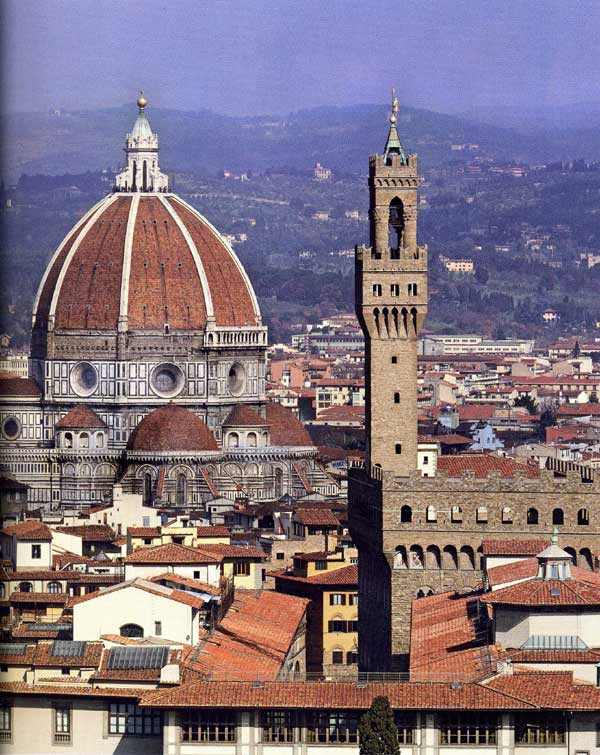
The fragmentation of Italy into city-states such as Florence, Venice, and Milan led to the rise of wealthy and influential families like the Medici in Florence. Florence, often considered the birthplace of the Renaissance, was the most influential of the Italian city-states. Under the Medici family's patronage, the artistic, literary, and philosophical community flourished, turning it into the cultural heart of Italy.
The Proto-Renaissance.
In Italy, the proto-Renaissance artists laid the foundations for the ground-breaking innovations of the fifteenth century. Taking place in the late 13th and early 14th centuries, the proto-Renaissance emerged primarily in northern Italy.
In the fourteenth century or Trecento, artists shed the mosaics associated with the Byzantine period and took inspiration from classical Greek and Roman sculptors.
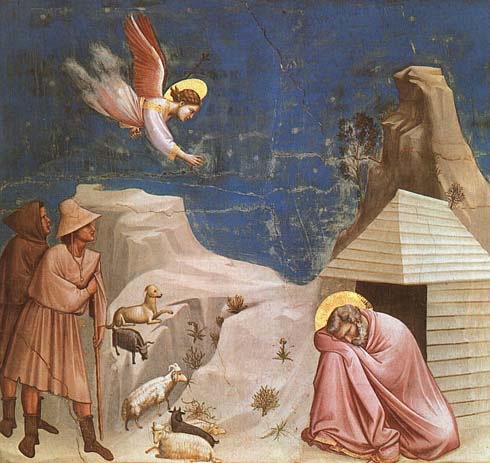
The artist Giotto di Bondone is the first painter to have broken with the tradition of Byzantine art at the end of the Middle Ages. Giotto made advances in representing the human body more realistically, his technique was the first to realise this change since the times of classical antiquity.
Giotto’s frescoes in the Scrovegni Chapel in Padua are elegant masterpieces that forsake the symbolic style of the bygone ages for the empirical study of nature and the human figure. Giotto and his contemporaries of the proto-Renaissance laid the groundwork for the innovations of the talented Renaissance artists that followed.
The Early Italian Renaissance.
After the death of Giotto in 1337, the main body of the Renaissance began to emerge. Classical Greek and Roman ideals along with new scientific discoveries fuelled by free-thinking, inquisitive individuals moulded fifteenth-century Italy into a hotbed of innovation.
We tend to assume that every age must be greater than the one that it preceded, but this is not always the case. The Roman Empire was the centre of world civilisation until its demise in 476. Europe had entered the Middle Ages or Dark Ages lasting for a thousand years. The lessons of classical antiquity, Greek and Roman sculpture, architecture and literature did not surface again until the start of the Renaissance in Italy. The beginnings of the Italian Renaissance centred on Tuscany and on Florence in particular.
The architect Filippo Brunelleschi was responsible for the emergence of both Renaissance architecture and perspective drawing, his work had a profound influence on the sculptors and painters of the day. The concept of linear perspective is regarded as a defining feature of Renaissance art, Brunelleschi was the first to re-discover this important science.
Brunelleschi's accurate and meticulous portrayal of architectural spaces marked a radical departure from the flat figures and disproportionate scales seen in medieval art. His design for the dome of the Florence Cathedral was not only an architectural triumph but also a symbol of the Renaissance.
Other notable architects include Leon Battista Alberti, whose treatises on architecture laid the groundwork for architectural theory, and Michelozzo di Bartolomeo, whose work shaped the look of Florentine Renaissance architecture.
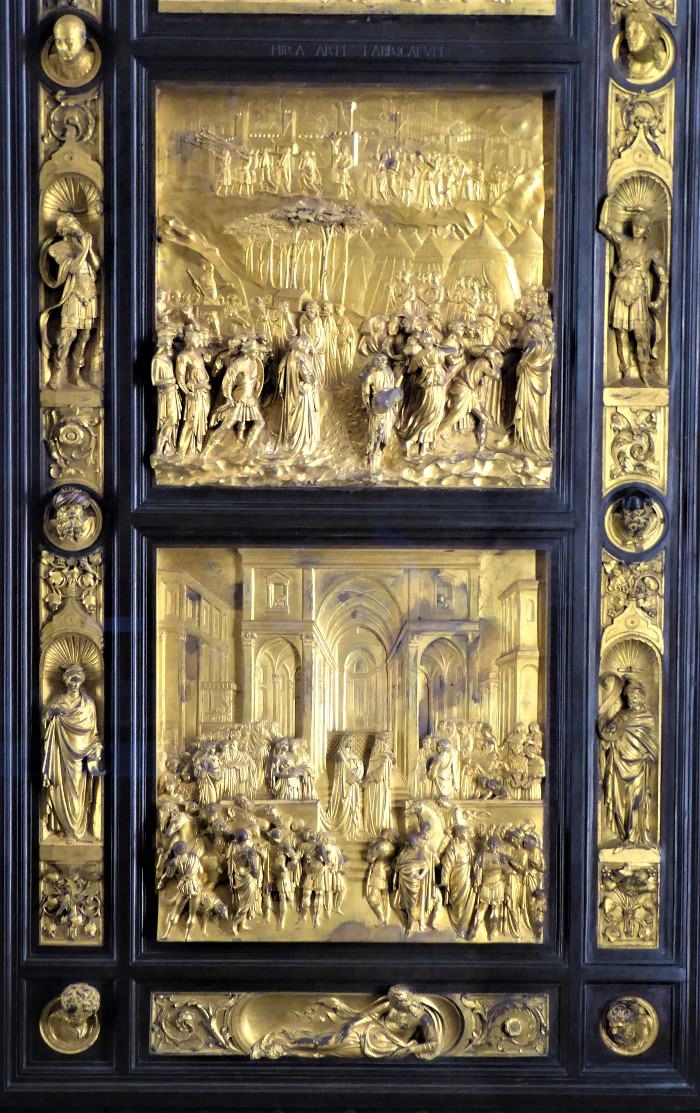
Equally instrumental in the evolution of Renaissance art, the sculptor Lorenzo Ghiberti is best known for the doors of the Florence Baptistery, also referred to as "The Gates of Paradise". His work embodies the Renaissance’s hallmark themes of proportion, perspective, and humanism.
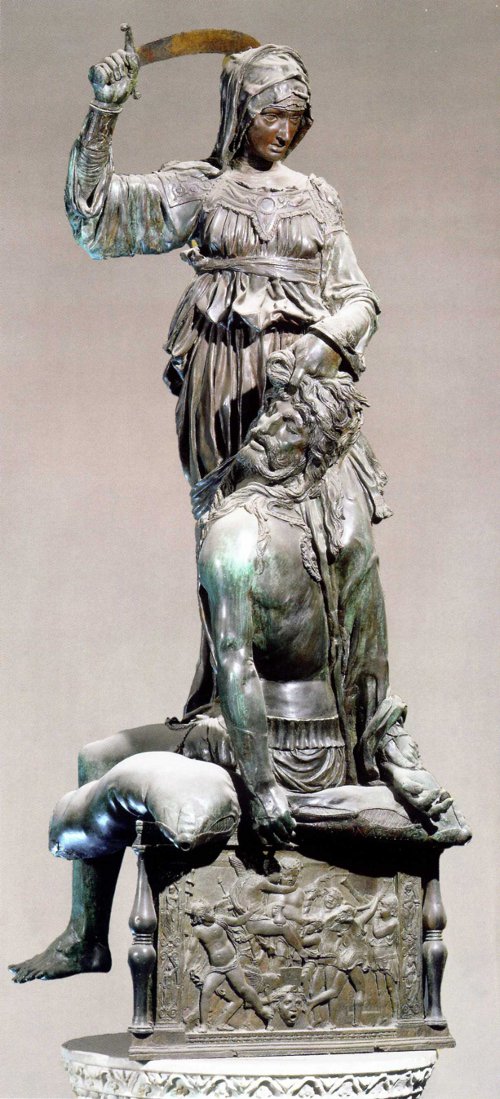
Donatello, a pioneering sculptor of the early Italian Renaissance, is praised for his realistic, highly emotional sculptures. His bronze statue of David is the first known free-standing nude statue produced since ancient times, marking a significant milestone in Renaissance art.
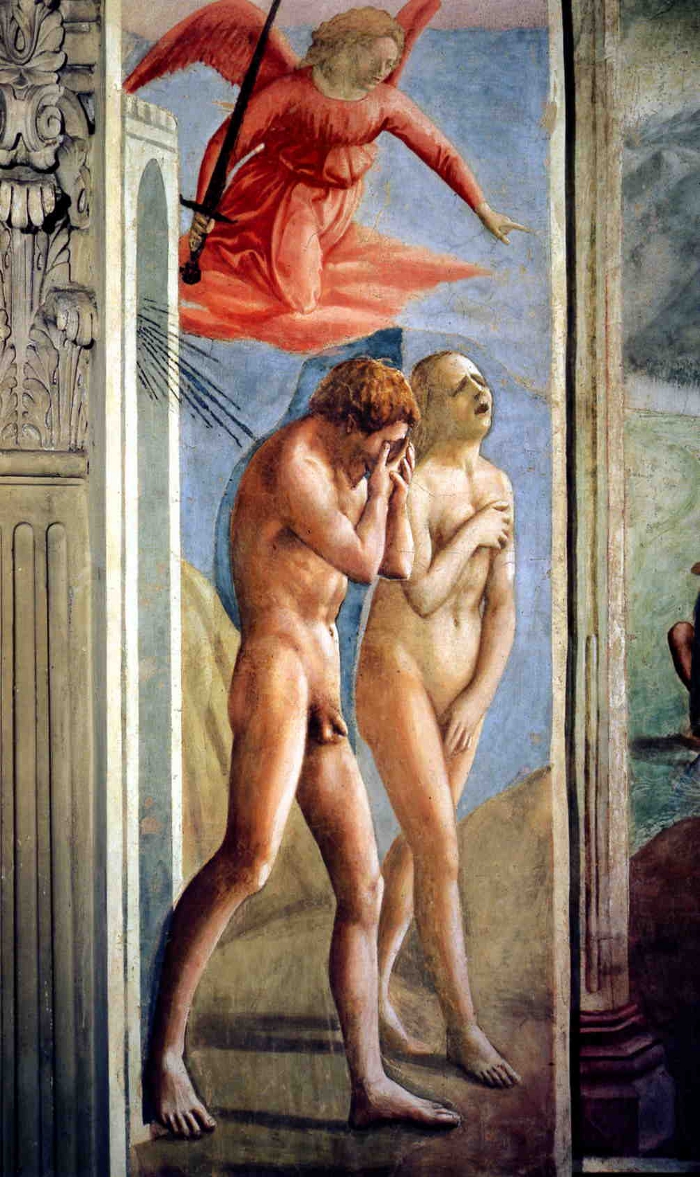
Tommaso di ser Giovanni di Simone Cassai, also known as Masaccio, was the most accomplished painter of the early fifteenth century. His paintings incorporate the lessons learned from his connections with Brunelleschi and Donatello. Masaccio’s frescoes in the Brancacci Chapel in Florence include one of his most famous and important works, "The Rendering of the Tribute Money".
Andrea Mantegna, with his meticulous, almost scientific precision in rendering perspective, particularly in his fresco paintings in the Ducal Palace in Mantua, contributed to the era. The most famous and dramatic of his perspective effects are found in his "Cristo Morto". This painting, representing Christ on his deathbed, was discovered in Mantegna’s studio after his death.
A defining figure of the early Renaissance was the genius artist, inventor, and engineer, Leonardo da Vinci. While his work also reaches into the High Renaissance, his early works, such as "The Virgin of the Rocks" and "The Baptism of Christ," mirror the stylistic transformations epitomized by the Renaissance.
Leonardo da Vinci's inquiring mind led to detailed anatomical sketches, demonstrating the convergence of art and science. His meticulous observations and recordings signify the budding spirit of the Renaissance man.
Renaissance Influences and Events.
The Black Death of 1348 swept across Europe; it has been estimated that one-third of the population died because of this devastating pandemic. This population decline continued and in 1450 the population of Europe was around half of what it had been in the early part of the fourteenth century.
This almost unique slump in population resulted in major cultural changes, land became more abundant, and labour became scarcer. The plague catalysed social and economic changes, leading to shifts in wealth and power that enabled vibrant cultural activity. This led to a society dependent on trade and industrial enterprise rather than on a land and rent-based system.
An equally vital event during this period was the invention of the printing press by Johannes Gutenberg in or around 1440. Before the printing press written works had been confined to manuscripts, Gutenberg's invention led to the production of affordable books that could be widely distributed on a scale that had been unimaginable previously. This significant development democratized knowledge, making books and literary materials more affordable and accessible. Consequently, literacy grew, and ideas spread swiftly, fuelling the Renaissance movement even more.
Another indispensable figure is the political thinker, diplomat, and historian Niccolò Machiavelli, whose seductively pragmatic positions on governance and power dynamics offered in "The Prince" represented the darker, more political side of Renaissance thought. A host of other factors, including legal reforms, military innovations, and shifts in religious beliefs, collectively set the stage for the dawn of the Italian Renaissance.
The early Italian Renaissance, undoubtedly, was a period of rebirth that moulded much of Western civilization. But apart from its unparalleled contribution to arts and sciences, the Renaissance era also fostered a spirit of curiosity, individualism, and humanism that would guide future generations. Even today, we observe the impact of the Renaissance in every preserved painting, sculpture, and architectural marvel scattered across Italy, particularly in its cradle, Florence.
The generation of artists that followed built on the innovations in art and science of the Renaissance. This led to the period known as the High Renaissance resulting in the rise of the great masters, Michelangelo, Raphael, and the previously noted Leonardo da Vinci.
You might like these
Piero della Francesca the renaissance artist from Sepolcro Tuscany.
Piero della Francesca, the highly regarded fifteenth-century painter from Tuscany.
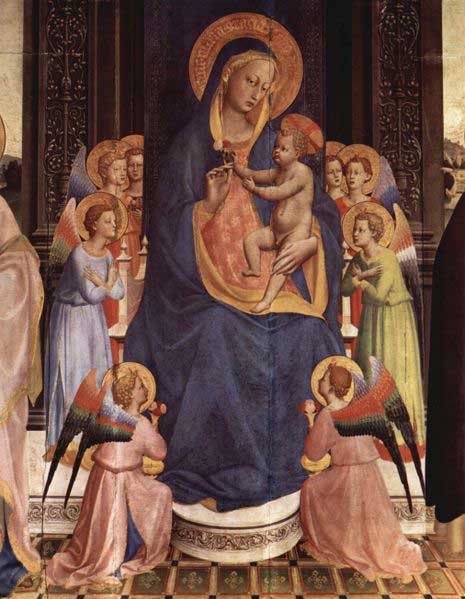
Fra Angelico the renaissance fresco painter.
Fra Angelico, the master painter of the frescoes in the monastery of San Marco
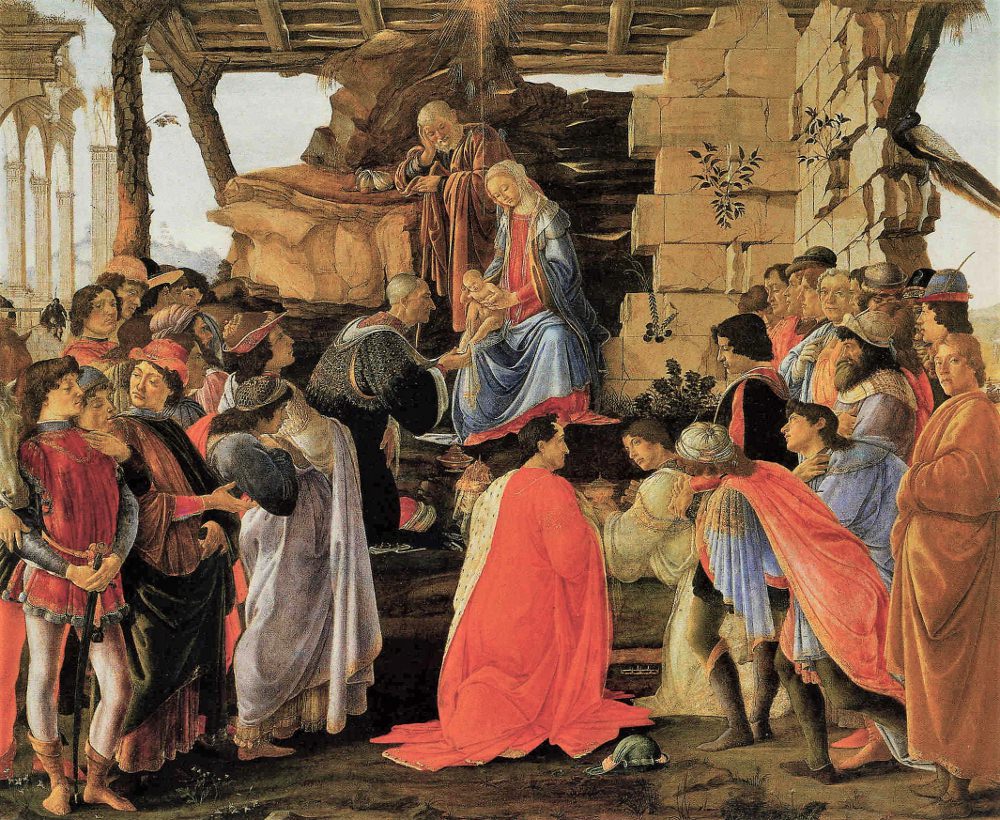
Sandro Botticelli the famous Italian Renaissance artist.
The life and work of the great Florentine artist Sandro Botticelli. The Birth of Venus, Primavera and more
The Medici, the family dynasty from Florence.
The Medici were the one of the most powerfull and wealthy families in Italy, They became major patrons of Renaissance art

- Home
- Early Italian Renaissance

Contact Details. Site Map. Site Author. Art Museums. Privacy Policy. News.
© Copyright, 2008-2025, by Vincent Finnan, Italian-Renaissance-Art.com