Early Italian Renaissance Artists - the Beginning of a New Age.
The early Italian Renaissance marked a shift away from the medieval ideas of the past. Huge cultural changes emerged within the Italian city states, particularly in Florence the undoubted epicentre of the Renaissance. The rise of wealthy families and merchants such as the Medici banking family marked a change from a land based system to a system based on commerce and trade. Under the patronage of the Medici, Princes and the church, the artistic, philosophical and literary community flourished.
Florence became a hotbed of innovation cementing its position as the most influential of the city states. Acting as a bridge between the Middle Ages and modern times the Renaissance serves as a pivotal point in European history.
The Proto-Renaissance.
The move away from a flat two-dimensional representation of reality expressed by the artists of the thirteenth century began in the fourteenth, the Trecento.
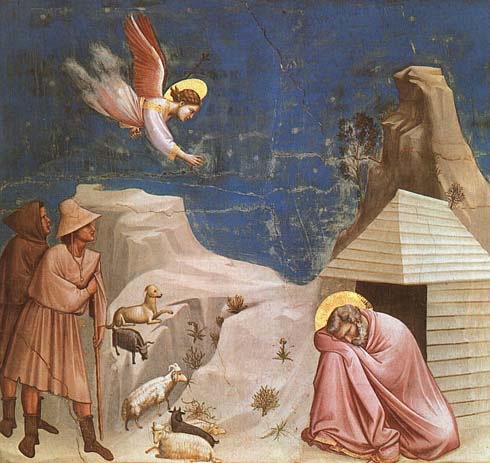
Breaking with the artistic traditions and mosaics of the Byzantine period at the end of the Middle Ages the Florentine artist Giotto de Bondone was the first to render the illusion of three-dimensional reality in paint on a flat surface. Giotto was the first to recapture a more realistic representation of the human body since the times of classical antiquity.
In the period known as the Proto-Renaissance Giotto and his contemporaries laid the foundation for the extraordinary innovations of the fifteenth century.
The Fifteenth Century Italian artists.
More than 80 years after Giotto’s death in 1337 another exceptional painter emerged from Florence. Tommaso di ser Giovanni di Simone Cassai, also known as Masaccio, was the most accomplished painter of the early fifteenth century. The Brancacci Chapel in Florence houses some of Masaccio’s finest frescoes including one of his most important works, ‘The Rendering of the Tribute Money’. Masaccio, along with Brunelleschi and the sculptor Donatello, are the trio of artists who represent the cornerstone of the early Italian Renaissance period.
The architect Filippo Brunelleschi pioneered the science of perspective, his experiments in and around Florence paved the way for artists to create a greater sense of realism into their paintings. Brunelleschi’s magnificent dome of Florence Cathedral is a lasting testament to the skill of a towering figure of the early Renaissance,
Fra Filippo Lippi. After the early death of his parents Lippi was placed in the Carmelite monastery in Florence. He was appointed chaplain to a convent in Florence where he met and formed a relationship Lucrezia Buti, the resulting romance produced a son, Filippino Lippi who also became a painter. Fra Filippo Lippi’s famous fresco, ‘The Feast of Herod’ in Prato Cathedral is an undoubted masterpiece of the early Renaissance.
Opinion-
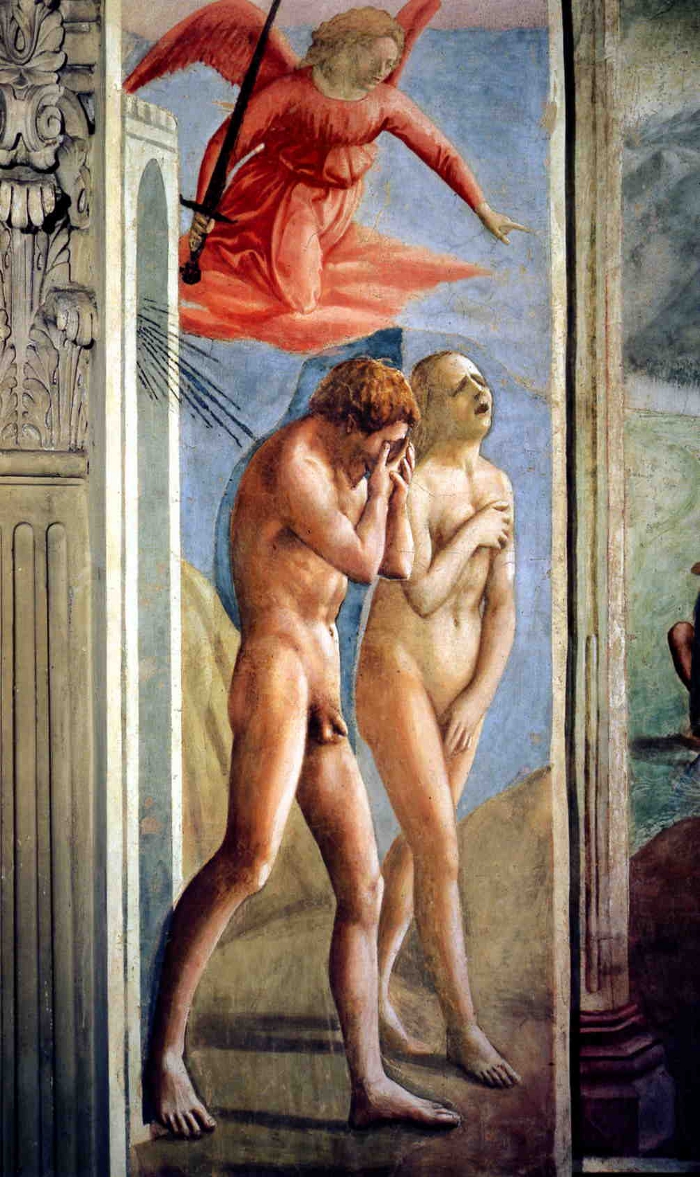
The Brancacci Chapel is located within the Church Santa Maria del Carmine. Although small it houses frescoes by Masaccio. Masolino, and Filippino Lippi-including the Expulsion of Adam and Eve-featured above. The Santa Maria del Carmine is situated in the Oltrarno district of the city, because of it's location it is often overlooked by visitors to Florence. However, Florence is a walking city I would urge art lovers to visit the masterpieces within the Chapel.
Born in the Republic of Venice Andrea Mantegna’s frescoes in the Camera degli Sposi, the bridal chamber of Ludovico Gonzaga who was the ruler of the city of Mantua, are astonishing. His final painting, a foreshortened figure of the dead Christ, was found in Mantegna’s studio after his death.

Sandro Botticelli is famous for his mythological paintings. A pupil of Fra Filippo Lippi, Botticelli was closely associated with the powerful Medici family of Florence. Located in the Uffizi Gallery, Sandro’s painting ‘The Birth of Venus’ is instantly recognisable as a modern icon.
The Dominican friar Fra Angelico is an important early Renaissance figure. His visually stunning frescoes in the monastery of San Marco in Florence are beautiful examples of religious art. Fra Angelico’s patron was the powerful Cosimo de Medici from the wealthy and hugely influential banking family.
Paolo Uccello was fascinated by the new science of perspective, this can be clearly seen the foreshortened figure in his famous painting ‘The Rout of San Morano’.
Piero della Francesca created his famous fresco cycle ‘The Story of the True Cross’ in the Basilica of San Francesco in Arezzo. Piero was acquainted with Masaccio Fra Angelico and Brunelleschi. Piero was an incredibly gifted artist who, perhaps because he never worked in Florence, was sadly not appreciated in his lifetime.
Domenico Ghirlandaio was a successful fresco painter, lauded by wealthy Florentine patrons he was the head of a formidable workshop. In 1481 he, along with other artists, was summoned to Rome and tasked to paint frescoes on the wall of the Sistine Chapel. Ghirlandaio’s contribution was his ‘The Vocation of Peter and Andrew’ on the right wall of the chapel.
It was in Ghirlandaio’s workshop that the young Michelangelo mastered the techniques of painting and draughtsmanship.
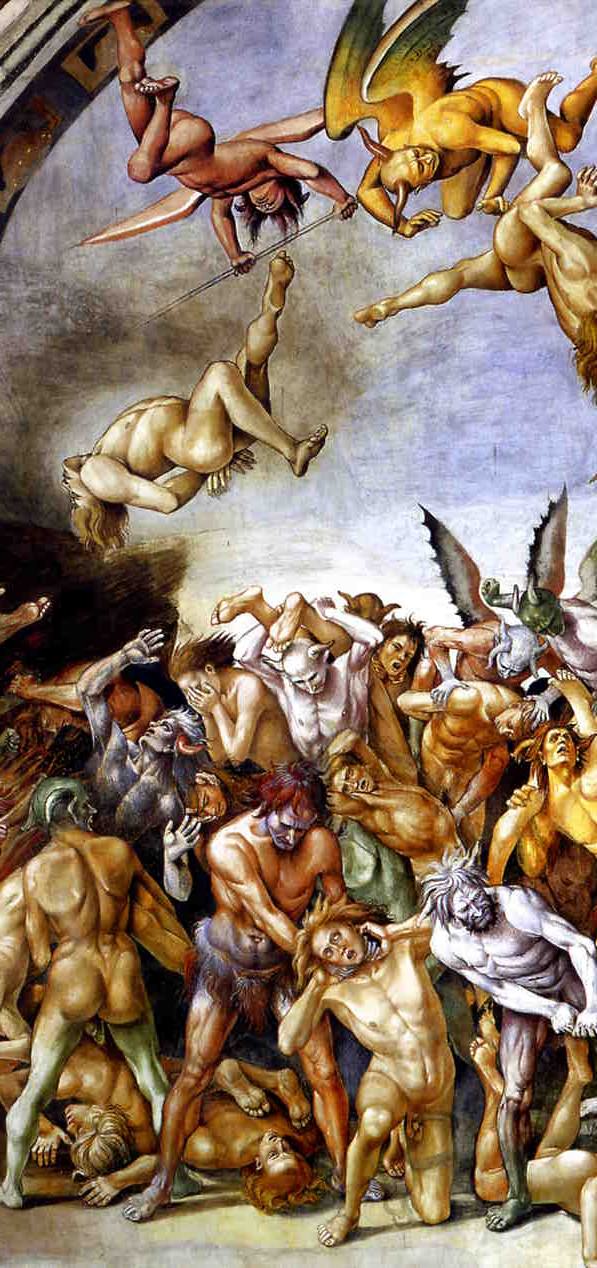
Luca Signorelli from the town of Cortona in Tuscany was among the group of artists summoned to decorate the walls of the Sistine Chapel in Rome. Signorelli’s contribution was ‘The Testament and Death of Moses’ painted in collaboration with Bartolomeo della Gatta. Influenced by Piero della Francesca and Pietro Perugino, Signorelli’s paintings in Orvieto Cathedral are considered to be his masterworks.
This series of paintings influenced Michelangelo’s huge fresco ‘The Last Judgement’ on the South wall of the Sistine Chapel.
Pietro Perugino from Umbria was an acclaimed master with a large workshop. He worked as a pupil under Piero della Francesca and in the workshop of Andrea del Verrocchio alongside Leonardo da Vinci and other gifted individuals. Pietro was yet another artist summoned to Rome to paint frescoes on the walls of the Sistine chapel. Aided by his considerable workshop his contributions were, ‘The Charge to St Peter’, ‘Moses leaving for Egypt’ and ‘The Baptism of Christ’.
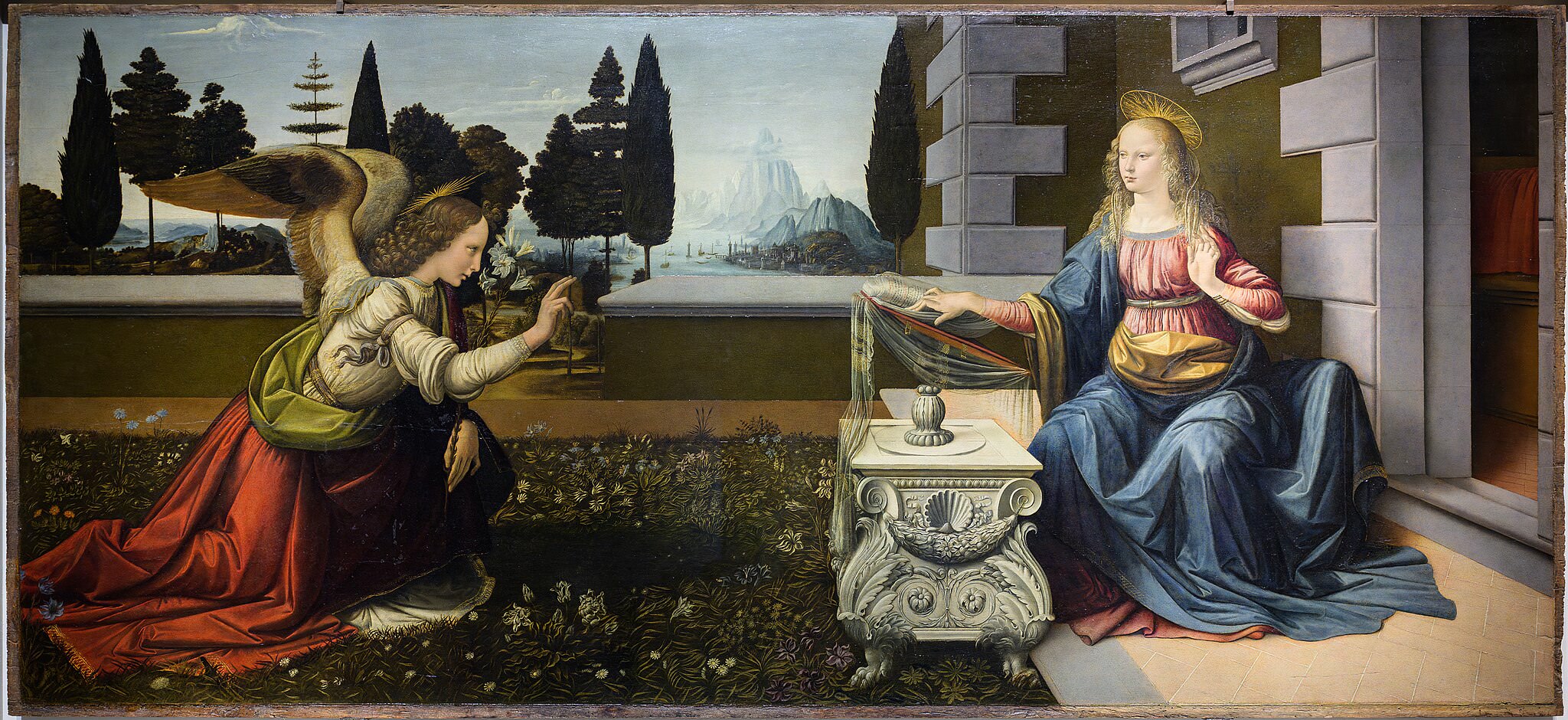
Leonardo da Vinci, an artist, scientist, biologist and engineer is a pivotal figure of the Renaissance era. His work spans both the Early Renaissance and the High Renaissance period and Leonardo was active long before the other two great High Renaissance masters Michelangelo and Raphael. His paintings of this early period include, ‘The Annunciation’ and ‘The Lady with an Ermine’. Leonardo da Vinci, a towering figure who epitomises the spirit of the Renaissance, is rightly regarded, even today, as one of the greatest intellectuals of all time.
We tend to assume that every age must be greater than the one that it preceded, but this is not always the case. The Roman Empire was the centre of world civilisation until its demise in 476. Europe had entered the Middle Ages or Dark Ages lasting for a thousand years. The lessons of classical antiquity, Greek and Roman sculpture, architecture and literature did not surface again until the start of the Renaissance in Italy.
Renaissance Influences and Events.
The Black Death of 1348 swept across Europe; it has been estimated that one-third of the population died because of this devastating pandemic. This population decline continued and in 1450 the population of Europe was around half of what it had been in the early part of the fourteenth century.
This almost unique slump in population resulted in major cultural changes, land became more abundant, and labour became scarcer. The plague catalysed social and economic changes, leading to shifts in wealth and power that enabled vibrant cultural activity. This led to a society dependent on trade and industrial enterprise rather than on a land and rent-based system.
An equally vital event during this period was the invention of the printing press by Johannes Gutenberg in or around 1440. Before the printing press written works had been confined to manuscripts, Gutenberg's invention led to the production of affordable books that could be widely distributed on a scale that had been unimaginable previously. This significant development democratized knowledge, making books and literary materials more affordable and accessible. Consequently, literacy grew, and ideas spread swiftly, fuelling the Renaissance movement even more.
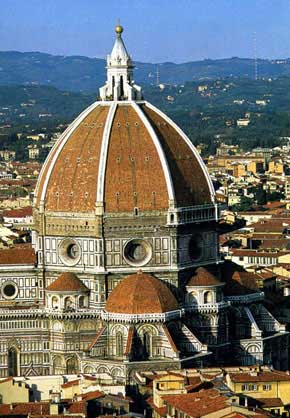 Filippo Brunelleschi, The Dome of Florence Cathedral.
Another indispensable figure is the political thinker, diplomat, and historian Niccolò Machiavelli, whose seductively pragmatic positions on governance and power dynamics offered in "The Prince" represented the darker, more political side of Renaissance thought. A host of other factors, including legal reforms, military innovations, and shifts in religious beliefs, collectively set the stage for the dawn of the Italian Renaissance.
The early Italian Renaissance, undoubtedly, was a period of rebirth that moulded much of Western civilization. But apart from its unparalleled contribution to arts and sciences, the Renaissance era also fostered a spirit of curiosity, individualism, and humanism that would guide future generations. Even today, we observe the impact of the Renaissance in every preserved painting, sculpture, and architectural marvel scattered across Italy, particularly in its cradle, Florence.
The generation of artists that followed built on the innovations in art and science of the Renaissance. This led to the period known as the High Renaissance resulting in the rise of the great masters, Michelangelo, Raphael, and Leonardo da Vinci.
Explore the High Renaissance.
- Home
- Early Italian Renaissance Artists

Contact Details. Site Map. Privacy policy. News.
© Copyright, 2008-2026, Italian-Renaissance-Art.com